
 CONTACT 13585206025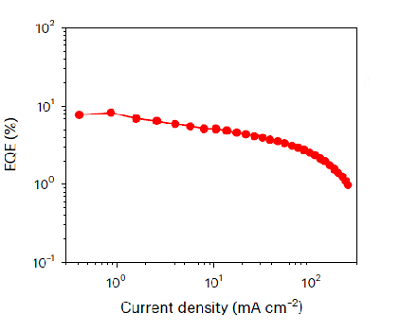
Solution treated metal halide perovskites have received great attention in the fields of information display, lighting, and energy production due to their excellent optoelectronic properties, good flexibility, and potential low cost. In recent years, efficient perovskite light-emitting diodes (LEDs) with external quantum efficiency (EQE) exceeding 20% have been reported. However, these achievements were based on lead halide perovskites, but the toxicity of lead has attracted widespread attention. Tin based perovskites have shown enormous potential due to their environmental safety and excellent optoelectronic properties in various lead-free perovskites. Recently, a research team led by Academician Huang Wei and Professor Wang Jianpu from the School of Flexible Electronics (Future Technology) at Nanjing Tech University has made significant breakthroughs in environmentally friendly perovskite light-emitting diodes, increasing the efficiency of tin based perovskite LEDs to 8.3% for the first time internationally.

Micro lasers, especially micro electrically pumped lasers, have significant research value in fields such as optical communication, optical computing, and optical storage. Perovskite prepared by solution method has excellent optical and electrical properties, making it a highly promising medium for electrically pumped laser gain. Recently, Wang Jianpu's research group at Nanjing University of Technology reported on the development of continuous wave (CW) optically pumped lasers in their latest research, which represents a crucial step towards electrically pumped perovskite lasers.
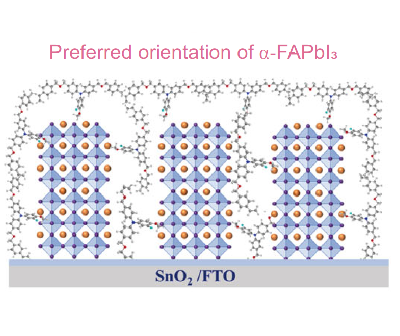
So far, most of the efficiency records of perovskite solar cells have been based on FA mixed ion perovskite, and the crystallization kinetics control of mixed ion perovskite films is the key to preparing efficient and stable perovskite solar cells. In view of this, on February 2, 2023, the team led by Wang Fangfang, Qin Tianshi, and Huang Wei from Nanjing Tech University published their latest research results in Nature Communications. Through the use of in-situ XRD, in-situ absorption, and in-situ GIWAXS, they thoroughly analyzed the intermediate phase, nucleation, and crystallization processes of perovskite films during spin coating and annealing. Research has found that mixed ion perovskites, due to the generation of multiple intermediate phases during film formation, have multiple nucleation pathways and are difficult to grow into ordered high crystalline films, which affects the efficiency and stability of perovskite solar cells.
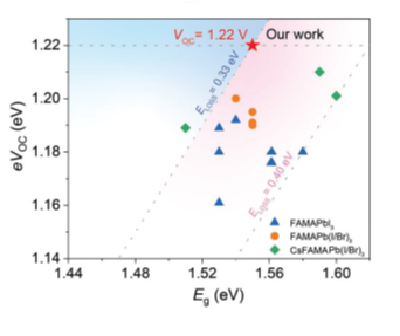
At present, organic inorganic metal halide perovskite solar cells (PSCs) are developing rapidly, and the certification efficiency has exceeded 25.7%. However, its efficiency still lags behind the Shockley Queisser theory, mainly due to the high energy loss of the device's open circuit voltage (Voc). Due to the polycrystalline nature of solution prepared perovskite films, grain boundary defects as non radiative recombination centers greatly affect the VOC of devices and limit further improvement in device efficiency. In view of this, on December 11, 2022, the team led by Wang Fangfang and Qin Tianshi from Nanjing University of Technology published the latest research results in AFM, which effectively passivated defects, reduced non radiative recombination, and achieved an ultra-high voltage of 1.22V, achieving an efficiency of 24.21%.
