 CONTACT 13585206025
 2023/9/25 20:08:43
 admin
admin
Overview:
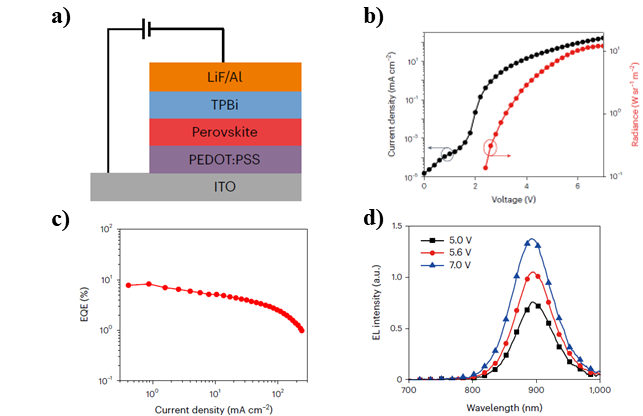
Solution treated metal halide perovskites have received great attention in the fields of information display, lighting, and energy production due to their excellent photoelectric performance, good flexibility, and potential low cost. In recent years, efficient perovskite light-emitting diodes (LEDs) with external quantum efficiency (EQE) exceeding 20% have been reported. However, these achievements were based on lead halide perovskites, but the toxicity of lead has attracted widespread attention. Tin based perovskites have shown enormous potential due to their environmental safety and excellent optoelectronic properties in various lead-free perovskites. Recently, a research team led by Academician Huang Wei and Professor Wang Jianpu from the School of Flexible Electronics (Future Technology) at Nanjing Tech University has made significant breakthroughs in environmentally friendly perovskite light-emitting diodes, increasing the efficiency of tin based perovskite LEDs to 8.3% for the first time internationally (Figure 1).
Article:
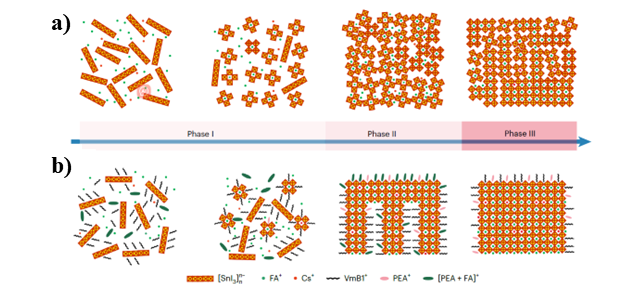
There are high-density defects in tin based perovskites, and achieving high efficiency devices remains a major challenge. The formation of defects in Sn based perovskites has not been well understood. In the article "Additive treatment yields high performance lead free perovskite light emitting diodes", the research team revealed that the main defects in Sn based perovskites were formed during the rapid cluster aggregation process during the initial growth process (starting from spin coating process~15 s), and~80% of the luminescence intensity was at 6 s. The author further found that additives that form strong chemical interactions with tin iodide (II) in precursor solutions can effectively prevent rapid cluster aggregation and avoid the formation of luminescent quenchers (Figure 2). By using this method, an effective external quantum efficiency of 8.3% was achieved for near-infrared lead-free perovskite light-emitting diodes.

Sample&Test:
In this article, the author used the products of Ouyi Optoelectronics to characterize the in situ PL of perovskite thin films in detail, with a time resolution of 10 ms, and can directly prove the evolution of crystal growth and defect formation during the perovskite crystallization process. As shown in Figures 1a and b, the perovskite luminescent material forms around 11 seconds after spin coating, followed by a rapid increase in PL intensity and a redshift in PL peak, indicating the formation of a large number of perovskite clusters and rapid crystal growth (Stage I). Then, the PL intensity suddenly decreased at 15 seconds, and approximately 80% of the intensity quenched within 6 seconds, indicating the formation of many luminescent quenchers (Stage II). The formation process of this instantaneous quencher can be attributed to the rapid aggregation of perovskite luminescent materials, as many defect rich regions can be formed during the imperfect arrangement of nanoparticles, leading to non radiative recombination. A similar trend was also observed in the FA0.9Cs0.1SnI3 sample based on PEAI (Figure 2c, d). The difference is that compared to its maximum PL intensity, the rapid PL decrease in FA0.9Cs0.1SnI3 perovskite based on PEAI is about 40%, indicating that PEAI can partially inhibit the Stage II process. The next step is a slow PL descent process (third stage), which should be due to surface defects formed during the removal of solvent ligands. Interestingly, by further adding 0.04 M vitamin B1 (VmB1) to the quasi 2D perovskite precursor solution (Figure 2e, f), the rapid decrease in PL completely disappeared, and the formation of perovskite luminescent materials was slightly delayed. This indicates that the addition of VmB1 effectively inhibits the aggregation induced PL quenching process in PEAI-VmB1 based FA0.9Cs0.1SnI3 perovskites (Stage II). Meanwhile, the author found that a single VmB1 additive can also eliminate PL quenching in FA0.9Cs0.1SnI3 perovskite. In addition, the sequential hot annealing process caused a red shift in the PL peak of all the aforementioned perovskites, which can be attributed to the growth of larger grains during the coarsening process. It is worth noting that the roughening process can only slightly improve the PL emission of the control and PEAI based perovskites; They maintain poor PL emission because most of the defects formed during the initial rapid growth process are retained in the perovskite microcrystals.

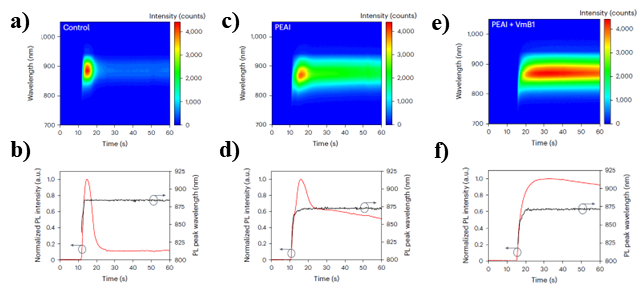
Figure 3. Application of Ouyi Optoelectronic Products in the Article
References:
【1】 H. Min, et al. Additive treatment yields high-performance lead-free perovskite light-emitting diodes. Nat. Photon.,17, 755. (2023)