 CONTACT 13585206025
 2020/11/4 15:10:17
 admin
admin

Overview:
At present, organic inorganic metal halide perovskite solar cells (PSCs) are developing rapidly, and the certification efficiency has exceeded 25.7%. However, its efficiency still lags behind the Shockley Queisser theory, mainly due to the high energy loss of the device's open circuit voltage (Voc). Due to the polycrystalline nature of solution prepared perovskite films, grain boundary defects as non radiative recombination centers greatly affect the VOC of devices and limit further improvement in device efficiency. In view of this, on December 11, 2022, the team led by Wang Fangfang and Qin Tianshi from Nanjing Tech University published the latest research results in AFM, which effectively passivated defects, reduced non radiative recombination, and achieved an ultra-high voltage of 1.22V, achieving an efficiency of 24.21%.
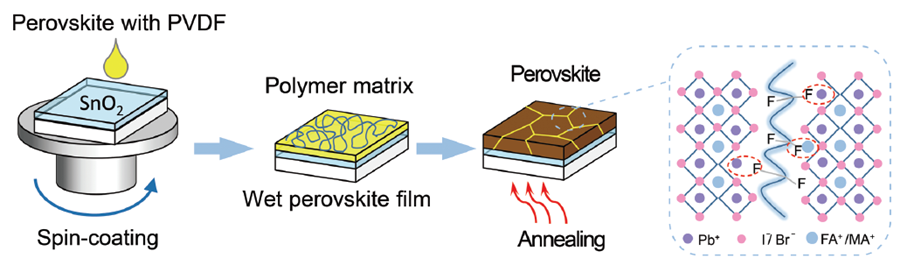
Figure 1. Schematic diagram of the preparation process of perovskite photovoltaic devices in this article
Article:
In "Over 24% efficient poly(vinylidene fluoride) (PVDF)-coordinated perovskite solar cells with a photovoltage up to 1.22 V In this paper, the research team uses polyvinylidene fluoride (PVDF) as a polymer template in perovskite films, and the fluorine atoms in PVDF can form strong hydrogen bonds with organic cations in perovskites and coordination bonds with Pb2+, thereby passivating perovskite film defects. The strong interaction between PVDF and perovskite can slow down the growth of perovskite crystals, effectively passivate defects, reduce non-radiative recombination, and significantly reduce the loss of Voc. The perovskite solar cell based on the addition of PVDF achieves an efficiency of 24.21% with an ultra-high voltage of 1.22V, which is one of the highest VOC values of the perovskite solar cell based on the FAMA system. In addition, the strong hydrophobic fluorine atoms in PVDF give the device excellent humidity stability, and the unpackaged solar cell still maintains more than 90% of its initial efficiency value after aging for 2500 hours in an air environment with ≈ 50% humidity, and the device maintains a high VOC of 1.20V throughout the aging process. This work demonstrates a strategy to effectively improve the voltage and efficiency of perovskite cells by using functional polymers to passivate perovskite defects, which is helpful for a deeper understanding of the effects of polymer materials on perovskite crystal growth and defect modulation.


Figure 2. Schematic diagram of Voc performance of perovskite photovoltaic devices in this article
Samples&Testing:
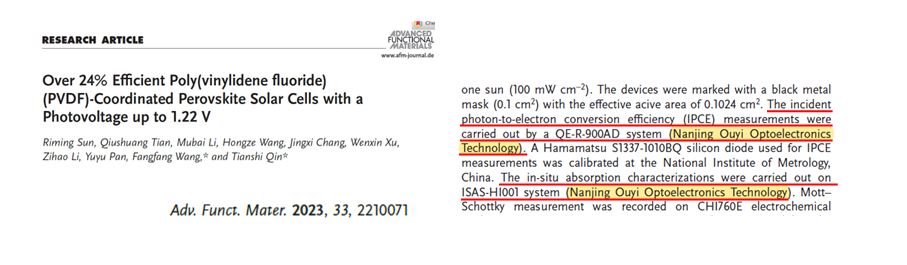
In this article, the author extensively characterized perovskite thin films/photovoltaic devices using multiple products from Eurovision Optoelectronics, including a) in situ absorption testing to deduce the crystallization process during perovskite spin coating and annealing; b) Test the quantum efficiency IPCE of perovskite photovoltaic devices; c) Combining Fourier transform to improve testing sensitivity and test the IPCE of perovskite photovoltaic devices.

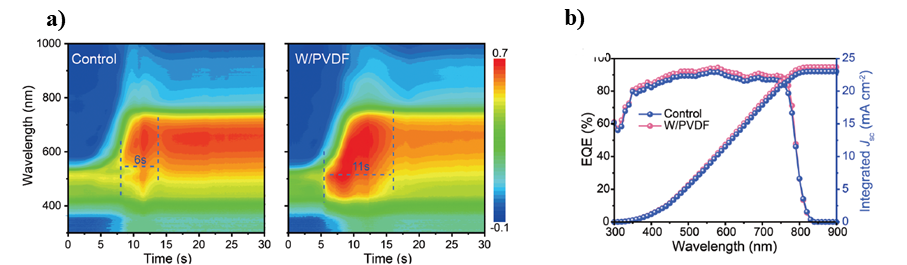
Figure 3. Application of Ouyi Optoelectronic Products in the Article
References:
【1】R. Sun, et al. Over 24% efficient poly(vinylidene fluoride) (PVDF)-coordinated perovskite solar cells with a photovoltage up to 1.22 V. Adv. Funct. Mater. 33, 2210071. (2023)