 CONTACT 13585206025
 2020/11/4 15:34:49
 admin
admin
Overview:
So far, most of the efficiency records of perovskite solar cells have been based on FA mixed ion perovskite, and the crystallization kinetics control of mixed ion perovskite films is the key to preparing efficient and stable perovskite solar cells. In view of this, on February 2, 2023, the team led by Wang Fangfang, Qin Tianshi, and Huang Wei from Nanjing Tech University published their latest research results in Nature Communications. Through the use of in-situ XRD, in-situ absorption, and in-situ GIWAXS, they thoroughly analyzed the intermediate phase, nucleation, and crystallization processes of perovskite films during spin coating and annealing. Research has found that mixed ion perovskites, due to the generation of multiple intermediate phases during film formation, have multiple nucleation pathways and are difficult to grow into ordered high crystalline films, which affects the efficiency and stability of perovskite solar cells.
Article:
In the article "Orientated crystallization of FA based perovskite via hydrogen bonded polymer network for effective and stable solar cells", the research team successfully designed a multifunctional fluorine substituted molecule FTPA as an additive, which acts as a downforce (1) to effectively transport holes and regulate energy levels in the bulk and surface of perovskite films; (2) Inhibiting the production of multiple intermediate phases and promoting α- Oriented crystallization of FAPbI3; (3) Promoted the sustained interaction between molecules and perovskite during spin coating and annealing processes; (4) Enable molecular filling of perovskite grain boundaries to form hydrogen bonding networks, effectively stabilizing them α- FAPbI3 (Figure 1). In the end, the perovskite solar cell based on FTPA achieved an efficiency of 24.10%. In addition, unpackaged solar cells exhibit excellent stability, maintaining over 95% of their initial efficiency value after continuous illumination for 1000 hours or accelerated aging in an air environment with ≈ 50% humidity for 2000 hours. Finally, the article also demonstrates the universality of the role of FTPA molecules in forward and reverse device structures and solar cells with different perovskite compositions. This work contributes to a deeper understanding of the crystallization kinetics mechanism and control methods in the preparation process of mixed ion perovskite, and provides important insights for the molecular design of new perovskite additives.
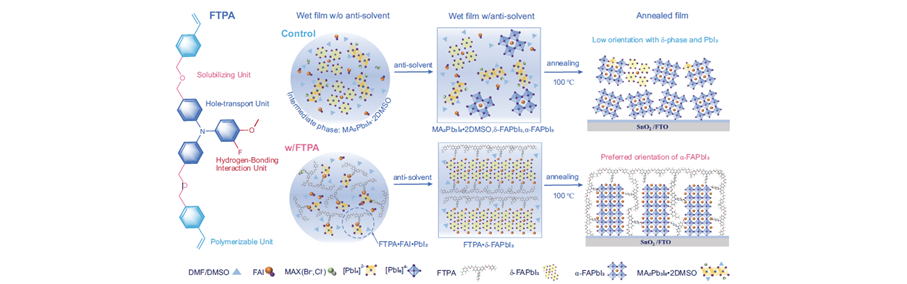
Figure 1. Schematic diagram of the multifunctional fluorine substituted molecule FTPA in this article
Samples&Testing:
In this article, the author extensively characterized perovskite thin films/photovoltaic devices using multiple products from Eurovision Optoelectronics, including a) in situ absorption testing to deduce the crystallization process during perovskite spin coating and annealing; b) Test the quantum efficiency IPCE of perovskite photovoltaic devices; c) Combining Fourier transform to improve testing sensitivity and test the IPCE of perovskite photovoltaic devices.
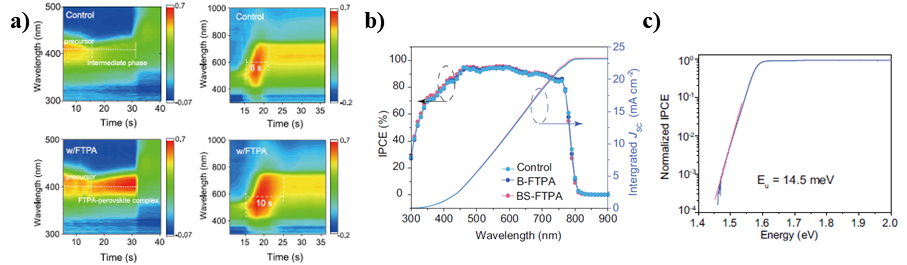
Figure 2. The application of Ouyi Optoelectronic products in this article
References:
【1】 M. Li, et. al. Orientated crystallization of FA-based perovskite via hydrogen-bonded polymer network for efficient and stable solar cells. Nat. Commun., 4, 573. (2023)